
Vintage Jewelry SEO: A Practical Guide for Jewelry Businesses
You can spend an afternoon researching a ring, photographing its details and writing a careful description, then watch it disappear into a website that barely brings anyone to the page. For a vintage jewelry business, that is more than a marketing frustration. The work that makes a piece worth buying is not reaching the people who would appreciate it.
Vintage jewelry SEO helps those people discover your inventory through search. It connects accurate product information, useful collections and accessible pages with a plan for what happens when individual pieces sell.
At GemRank SEO, five years of SEO experience inform a practical starting point: build visibility around both the pieces you have today and the types of jewelry you expect to keep sourcing.
Start with the inventory you can support
Before choosing keywords, look at what you regularly sell. A dealer specializing in vintage signet rings needs a different search structure from a business offering occasional rings among a broad selection of costume jewelry.
Make a short inventory map. Record recurring product types, documented periods or decades, materials, gemstones and recognizable styles. Separate dependable stock categories from exceptional acquisitions. That distinction helps you decide which subjects deserve permanent collection pages.
A hypothetical dealer who regularly sources vintage gold signet rings could support a lasting collection around that category. One unusual sapphire ring might deserve an excellent product page, but not an entire category that becomes empty immediately after a sale.
You should be able to maintain important pages without constantly inventing a reason for them to exist.
Give each search the right destination
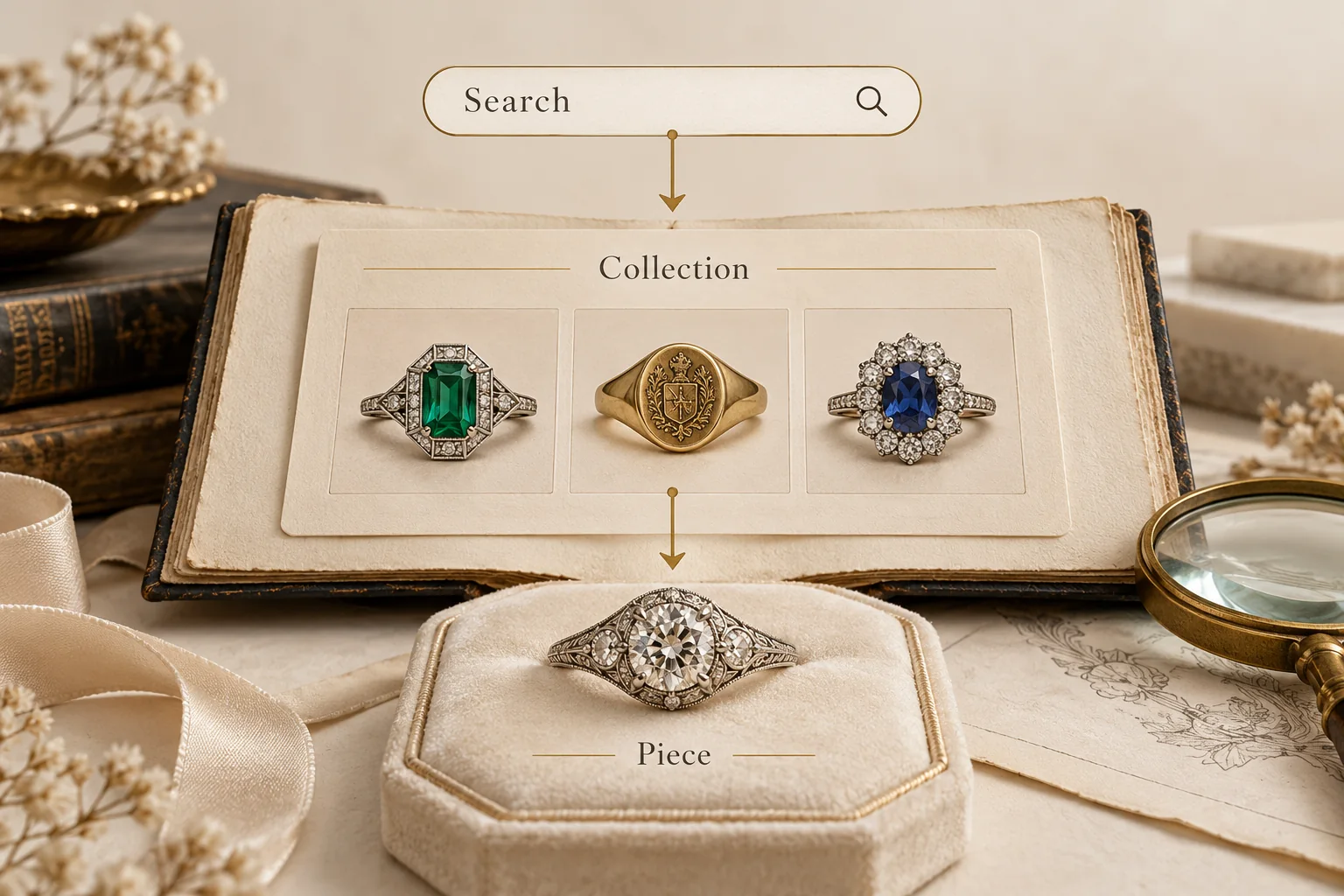
A keyword is useful only when you understand what the searcher wants to do. Someone looking for “vintage gold signet rings” may want a selection. Someone searching a precise ring description may be comparing individual pieces. A person asking about a particular style needs an explanation before a checkout button.
| Example search | Possible destination | What the page needs |
|---|---|---|
| vintage gold signet rings | Collection | Relevant available pieces and shopping context |
| vintage sapphire cluster ring in yellow gold | Product or focused collection | Accurate matching inventory and clear details |
| how to choose a vintage ring size | Guide | Practical explanations and relevant jewelry links |
These are illustrative query ideas, not measured search-volume findings. Check current results and your own search data before assigning them to pages. Results can show mixed intentions, so use this map as a starting point rather than a fixed rule.
Avoid making your homepage, collection and blog compete for the same phrase with nearly identical copy. Each should have a useful job.
Make product descriptions carry the details
Your customer cannot inspect the piece across a counter. Product copy needs to supply the facts that photographs cannot establish on their own.
Include the product type, supported age attribution, metal, gemstone information, dimensions, size, condition and relevant alterations. Describe what is known, estimated or unconfirmed. An uncertain date should remain uncertain after the copy has been optimized.
Consider this hypothetical title improvement:
Vague: The Eleanor Ring Clearer: Vintage Sapphire Cluster Ring in 18k Yellow Gold
The second title is appropriate only if those details are documented. Keep a distinctive inventory name as a secondary element if it helps your brand, but do not make shoppers decode it to understand the item.
A short opening paragraph can describe the ring plainly. A specifications section can hold measurements and condition. A separate story paragraph can explain design details without burying purchase information. This respects both the piece and the buyer’s time.
Build collections that outlast individual pieces
Product pages change as inventory sells. A well-maintained collection can continue helping shoppers find relevant alternatives.
Think about collections as shopping destinations. A vintage engagement rings page might explain available styles, sizing considerations and how to compare listings. It should not begin with several screens of generic history before visitors see the rings.
Google recommends linking through categories to products so important pages can be discovered through navigation. See its ecommerce website structure guidance.
Choose names that explain what belongs there. Keep filters useful, and check that products remain reachable through ordinary links. A private internal search box should not be the only way to discover a piece.
Our product and collection SEO service looks at these pages together because their relationship matters as much as either page alone.
Decide what happens after a sale
Do not apply one automatic rule to every sold item. Some pages continue to answer useful questions, attract relevant visitors or demonstrate the kind of inventory you source. Others have little lasting value.
For a useful archive page, clearly mark the piece as sold, remove misleading purchasing signals and offer relevant available alternatives. Keep the original description accurate. An archive should help a visitor understand what happened and what they can do next.
If a page is permanently replaced by a genuinely equivalent destination, a permanent redirect may be appropriate. Google’s redirect guidance explains that permanent redirects communicate a lasting move. Redirecting every sold ring to an unrelated homepage often disappoints the visitor.
Document the rule your team will follow. A manageable sold-item policy is better than a growing collection of contradictory pages.
Use photographs to answer buying questions
Plan photographs around what a buyer needs to inspect: the overall piece, side profile, setting, scale, marks and visible wear. Give images sensible filenames and alt text describing what is actually shown.
“Side view of a vintage sapphire cluster ring showing the raised setting” is more useful than a string of sales keywords. Keep essential facts in readable page text as well. Optimize image delivery so close-up detail remains available without making the first mobile view unnecessarily heavy.
Make your information useful for modern search
Clear facts also matter when people use AI-powered search. Keep descriptions, specifications and availability consistent. Explain specialist terms where a buyer would benefit, and support historical claims with appropriate evidence.
Google’s AI optimization guidance is a current reference. Inclusion cannot be guaranteed by adding a special phrase. Treat clear information as a foundation, not a promise of citations.
A realistic first month
Review one dependable collection, five representative product listings and the route a mobile visitor takes between them. Fix inaccurate information and obvious navigation problems first.
Record a baseline: relevant queries, organic visits and genuine inquiries or purchases where measurement is available. Compare similar periods and account for inventory changes before interpreting movement.
Your first objective is a better path from a search to a relevant piece. Explore our vintage jewelry SEO service or tell us about your business.
The care you put into sourcing should be visible in the way your website helps people discover what you sell.