Antique Jewelry SEO: How to Get Your Jewelry Found Online
An antique jewelry listing can contain weeks of work in a few paragraphs. You may have examined marks, checked a setting, compared references and decided how confidently to describe the period. Yet online, that care can be reduced to a photograph and a title that gives a searcher very little to work with.
Antique jewelry SEO makes your expertise and inventory easier to discover without compromising the accuracy of either. Start with precise descriptions, useful shopping categories and clear evidence for the claims that make a piece distinctive.
GemRank SEO brings five years of SEO experience to this work. Our approach is to translate a dealer’s knowledge into useful page structure, rather than replacing specialist judgment with a keyword checklist.
Separate interest from buying intent
An antique jewelry search can mean several things. A person may want to identify an inherited brooch, learn about a period or buy a piece. These visitors need different information.
Search your proposed topic and examine the results. Are they dealer collections, individual listings, reference guides or identification discussions? That helps you judge whether a collection, product page or article belongs in the plan. It does not establish search volume or guarantee identical results for every customer.
Ask whether your page can satisfy the visitor’s next decision. A period guide may introduce your expertise. A collection should help someone compare available jewelry. A product page must explain the actual item and how to purchase or inquire.
Build a vocabulary your inventory can defend
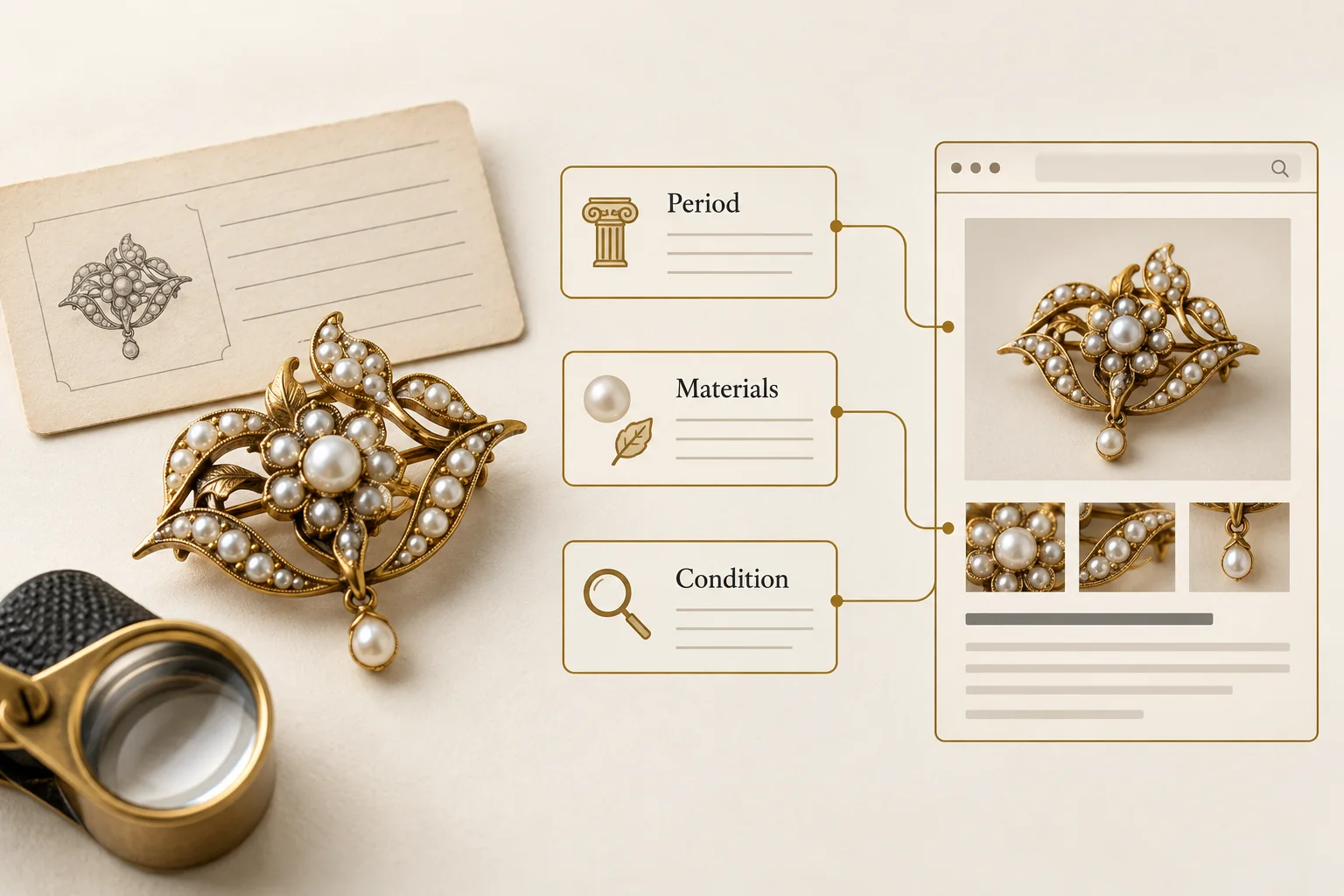
Make a working list of the terms you use to describe stock: period, style, jewelry type, material, gemstone, construction, maker and condition where supported.
Keep attribution separate from appearance. “Victorian-style” is different from an item attributed to the Victorian period. A maker’s name should not become a keyword on an unverified piece because similar designs appear in search results.
| Description issue | Better editorial decision |
|---|---|
| Date is uncertain | Explain the estimated attribution and its basis |
| Hallmark is partly worn | Describe what remains legible and what is unconfirmed |
| Stone identification is undocumented | Obtain appropriate verification or state the limitation |
| Later repair is known | Disclose it where a buyer will see it |
This discipline protects trust and gives your team a consistent way to write listings when stock arrives quickly but research takes time.
Turn a listing into a buying page
Imagine a hypothetical dealer listing a documented antique gold locket. A poetic title such as “A Secret to Keep” provides little search context. “Antique Gold Locket With Engraved Floral Detail” is clearer, provided it matches the piece.
A useful page could open with what the item is, then provide dimensions, supported metal information, interior configuration, closure condition and relevant wear. Photographs should show the features discussed. If a mark supports an attribution, describe the reasoning carefully instead of treating a close-up as self-explanatory proof.
Put essential facts before the longer history. A customer deciding whether the locket will hold a photograph should not have to read an essay to find its interior measurements.
Use readable titles and headings. Listing every possible period and gemstone creates confusion about what is actually being sold. Our product and collection SEO service considers clarity alongside search relevance.
Organize the store around meaningful choices
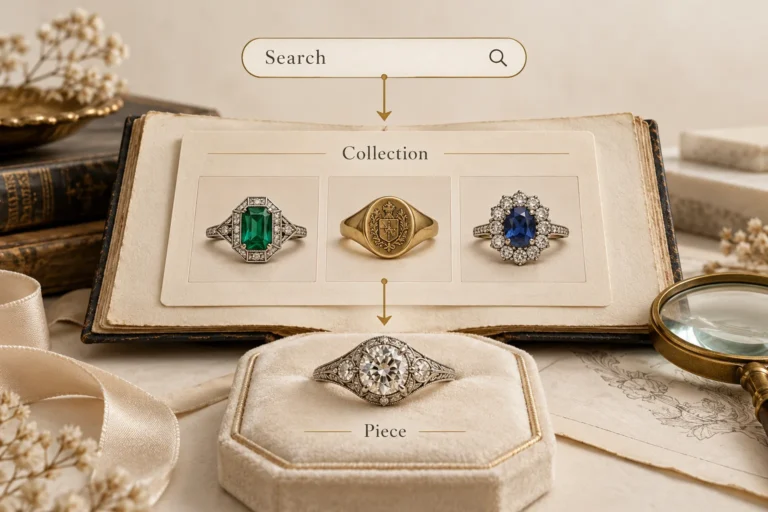
Your structure should reflect buyer needs and inventory you can maintain. Jewelry type may provide the broadest route: rings, brooches, necklaces or lockets. A supported period or material can provide a focused route when there is enough relevant stock.
Avoid creating a permanent page for every attribute combination. An empty “antique gold pearl mourning brooches” page is not automatically useful because the phrase is specific.
Decide which collections can continue serving customers after individual items sell. Add a concise introduction explaining what visitors can browse and which details distinguish the selection. Keep the grid close to the top, with deeper explanations below or in a linked guide.
Where a collection crosses periods, say so. A customer’s understanding should not depend on knowing your internal tagging system.
Show the expertise behind the description
An antique buyer may need reassurance before contacting a dealer they have never met. Give them practical reasons to trust the information.
Explain your actual description and inspection process. Provide the business contact route, purchasing policies and a clear way to ask a question. Share qualifications only when real and relevant. Do not imply gemological credentials you do not hold.
For educational content, identify the author and cite references supporting specialist claims. Google’s people-first content guidance emphasizes useful, reliable information and evidence of expertise.
Distinguish observations from historical claims. “The hinge shows wear in this photograph” is an observation. “This belonged to a royal family” is a provenance claim requiring evidence.
Make the technical facts agree
Visible price, availability and product information should match what your website supplies to search systems. Google’s product structured data overview describes eligible product search features.
Check actual output before assuming a theme or plugin has handled everything. Never add invented reviews, ratings or identifiers to fill a field. A unique piece needs accurate information, not a fabricated barcode.
Review mobile loading, product links and important pages that have accidentally become inaccessible. Technical SEO should preserve the substance of your inventory, not make the site harder to manage.
Keep sold pieces honest and useful
An archive can show the jewelry you handle, but it needs a purpose. Mark sold pieces visibly and distinguish them from available inventory. Link to relevant alternatives rather than implying the original is still purchasable.
Consider whether a page helps someone learn, browse or ask about future sourcing. If it does none of those things, retaining it indefinitely may add maintenance work without improving the customer experience.
Write a consistent availability policy. Assign responsibility for checking the visible label, purchasing controls and associated product data after a sale.
Prepare for detailed search questions
A search system may encounter your page while answering a question about an item or period. Make facts easy to locate, explain attribution limits and cite suitable references in educational articles.
A direct answer about condition or construction is often more useful than another promotional paragraph. AI visibility cannot be promised, and it should not tempt you to simplify uncertainty into false certainty.
For example, a hypothetical FAQ could ask whether a locket’s interior has been replaced. If the answer is unknown, say that and provide the clearest available photographs. If a replacement is documented, explain it before the buyer has to ask. That level of specificity creates useful information without pretending every historic piece has a complete record.
Choose an improvement you can maintain
Start with one collection and representative listings. Make descriptions consistent, check that photographs support the facts and follow the mobile route from collection to inquiry.
Record changes and review relevant traffic and genuine inquiries where measurement is available. The plan should be specific enough that your team can explain what it did and why.
Our antique jewelry SEO service connects these decisions across content and technical foundations. If your inventory deserves a clearer route to discovery, tell us what you sell.