Jewelry Keyword Research Beyond “Diamond Rings”

A broad keyword can make a small jewelry business feel invisible before the work begins. You compare your shop with national retailers, see the size of their catalogs and wonder where your own pieces fit. The more useful starting point is the set of decisions your particular customers are trying to make.
Jewelry keyword research should connect real inventory with real intent. That means examining materials, construction, style, fit, occasions and questions without turning every possible combination into a new page. This guide focuses on finding useful opportunities across different jewelry types, then deciding which ones deserve your time.
Begin with the inventory you can explain well
Choose three product families that matter commercially to your business. These might be lockets, signet rings and brooches, or handmade earrings, chain necklaces and wedding bands. Start with areas where you have enough stock or expertise to give the searcher a satisfying answer.
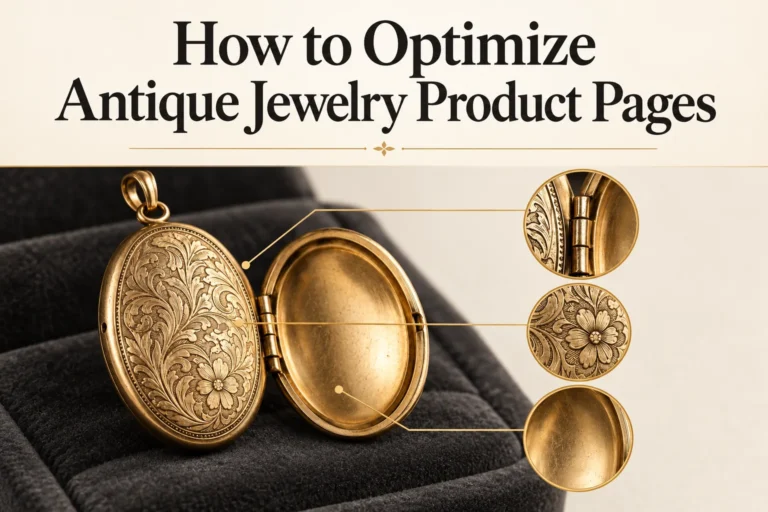
For each family, list supported attributes. A locket may vary by shape, metal, engraving, dimensions and what it holds. Earrings may vary by fastening, length, weight and whether they are sold as a pair. These differences create useful research directions because they change the buying decision.
Do not build the list from desirable words alone. If your business cannot substantiate a claim such as untreated or handmade, it should not become an SEO target. Research should help you describe the offer, not reshape the facts to match a search phrase.
Separate product language from buyer language
A knowledgeable dealer and a first-time buyer may describe the same feature differently. Keep both vocabularies in your research notes. The task is to make the relationship understandable while preserving accuracy, rather than replacing specialist terminology with vague popular language.
Customer inquiries are especially useful here. A question about a necklace tangling, a locket fitting a photograph or earrings feeling heavy can reveal the information missing from the site. It does not automatically establish search volume, but it gives you a concrete problem to investigate.
Where available, use your own search data. Google’s performance-report documentation explains how queries and landing pages can be examined. Remember that the report reflects your current visibility; it is not a complete inventory of everything potential customers search for.
Build candidates around meaningful distinctions
Combine a product family with an attribute only when the combination describes a real offer or useful question. Then inspect current results for the candidate. Look for whether people are being served product listings, collections, explanations, local businesses or a mixture.
| Candidate query | Likely question to investigate | Possible destination |
|---|---|---|
| Small gold locket | What compact options are available? | Collection if stock supports it |
| Does a locket include a chain? | What will I receive? | Product detail or clear buying explanation |
| Screw-back vintage earrings | Which available pairs use this fastening? | Relevant collection or product listing |
| How to measure a pendant | How should I compare size? | Practical guide with a diagram |
These are illustrative research candidates, not measured keyword recommendations. The result type and your ability to answer it should influence the destination. Do not create a collection merely because a phrase fits a formula.
Look for the missing decision in competing pages
Review a small set of relevant results with a specific question: what would a buyer still need to know after reading this? You may notice that dimensions lack context, fastening details are unclear or a guide never explains how the information affects a purchase.
That gap can inform a better page, but avoid claiming competitors are wrong simply because they take a different approach. Some pages serve a different audience or inventory model. Record what is observable and decide whether your business can offer something more useful for its own customers.
Do not copy a competitor’s product facts, photographs or personal experiences. Build examples from your own verified records, or label hypothetical examples clearly. The value should come from the quality of your explanation and evidence, not a rewritten version of someone else’s story.
Choose one owner for each search intent
Map related phrases to the page that best answers their shared purpose. Small gold lockets and compact gold lockets may belong together. A guide to measuring a locket serves a different purpose and can support that collection through a relevant link.
This does not mean every similar phrase must always share a page. It means the decision follows the visitor’s task rather than superficial wording. Compare the search results and your actual offering before splitting or combining destinations.
Keep a map with the candidate, intent, intended page, evidence and next action. If an existing page already serves the need, improve it before creating another. A growing list of almost identical URLs is usually harder to maintain than a smaller set of clearly useful pages.
Prioritize with evidence and business judgment
If you have access to a keyword tool, record the market, date and the tool’s estimates. Search volume and difficulty are estimates, not promises. If you do not have those measurements, label them unmeasured rather than inventing figures to make a spreadsheet appear complete.
Use practical criteria alongside the data. Can you keep serving this inventory? Does the page have a clear commercial role? Can you provide better information? Is the work manageable? A modest opportunity closely tied to your stock can deserve attention before a broader term with little connection to the business.
For a hypothetical dealer, improving an existing lockets collection might take priority over launching an extensive diamond education section. The decision follows the sourcing strength and customer need, not a universal rule about which jewelry keyword is best.
Place the language where it helps understanding
Use the main topic in a clear title and heading, then write naturally. Supporting terms belong where they describe the product or explain a distinction. Do not force a phrase into every heading, photograph description or link.
Clear answers also support people discovering information through AI-assisted search. There is no benefit in publishing separate paragraphs for every possible wording when one well-developed explanation serves the reader. Keep the important facts visible and the relationship between pages easy to follow.
Review the map as inventory and customer questions change. Research is a continuing choice about which needs your site should serve, not a file to complete once and forget. Record changes so you can understand later why a page was created or revised.
Drawing on five years of SEO experience, GemRank SEO helps jewelry businesses turn research into a practical page plan. Explore our keyword and content strategy service or the more specialized vintage jewelry keyword research guide. If the next priority is unclear, share your website and inventory focus.