Antique Jewelry SEO Starts With Accurate Details
A phrase can make a piece sound more desirable while making the listing less trustworthy. An estimated period becomes a precise year. A style reference becomes an attribution. A document about one gemstone becomes a claim that the whole piece is certified. These changes can happen during ordinary copy editing, without anyone intending to mislead.
Antique jewelry SEO needs a reliable path from evidence to published wording. The purpose of this article is to help a business organize that path: record what is known, preserve uncertainty, assign review responsibility and keep corrections consistent across the website. Better search language should clarify the piece, not make its history more certain than the evidence allows.
Separate three kinds of information
Begin with observed facts, supported conclusions and unresolved questions. A measurement taken by your team belongs in a different category from a date estimated by a specialist. A mark visible in a photograph is not automatically a confirmed maker attribution.
Store the basis for each important statement in the product record. That might be a report, an inspection note, a documented reference or a qualified expert’s assessment. The record should also identify who supplied the information and when it was reviewed.
This does not mean publishing every internal note. It means the person writing the listing can distinguish what the business can say confidently from what needs qualification. A simple evidence record is often more useful than a folder of documents with no connection to the claims being made.
Keep period and appearance distinct
Jewelry can resemble a historical style without being made during that period. If your evidence supports a style description but not a date, keep that distinction visible. Search demand for a period term is not a reason to remove the qualification.
The same care applies when components have different histories. A stone, setting, clasp or later conversion may require separate explanation. Do not compress a complex object into a single confident label simply because a short title looks cleaner.
A knowledgeable buyer may appreciate the precision. A less experienced buyer needs it even more, because they may not recognize the distinction from photographs alone. Good content gives both readers a fair basis for understanding the offer.
Make the document’s scope clear
If a product has a report, explain what it covers. Identify the relevant stone or item, the issuing organization and the information the document actually provides. Avoid expanding its meaning to unrelated features of the piece.
GIA describes the work involved in colored-stone identification. Use the actual report and qualified advice for an individual item. General educational information cannot establish a gemstone’s identity, treatment status or origin from a photograph.
Likewise, an appraisal and a historical attribution are not interchangeable descriptions of evidence. Ask the appropriate specialist when the documents do not support the wording you intend to publish. It is better to resolve that gap before the listing appears in several sales channels.
Use an evidence-to-copy worksheet
| Record field | Example of what to retain | Writing implication |
|---|---|---|
| Observation | A visible mark photographed clearly | Describe the mark without automatically assigning a maker |
| Assessment | Period estimated by an identified reviewer | Preserve the estimate and its appropriate qualification |
| Report | Document relates to the center stone | Limit the statement to the report’s actual scope |
| Condition | Repair observed during inspection | Explain the relevant condition and provide a useful view |
These are hypothetical workflow examples, not assessments of specific jewelry. The worksheet helps an editor know when to write, when to qualify and when to return a question to the person responsible for the piece.
Add a final approval field to the record. The person checking jewelry facts may not be the person optimizing the page title. Both roles matter, but one should not silently override the other’s work. Record changes so the next editor can understand why a phrase was chosen.
Keep accuracy through the short fields
The main description is only one version of your product information. The collection card, title tag, image description, merchant feed and social preview may each contain shorter wording. Those shortened versions need to preserve material qualifications.
For example, a body paragraph explaining that a piece is in an earlier style does not correct a card title that states the earlier period as fact. Review the short fields together with the full listing. This is where well-intentioned simplification can cause the most confusion.
Use the core product description naturally in the page heading and opening. Supporting details should appear where they help a buyer understand the item. Avoid adding speculative terms to capture more searches. A visitor attracted by an inaccurate label is not the discovery you want.
Photograph evidence, not just beauty
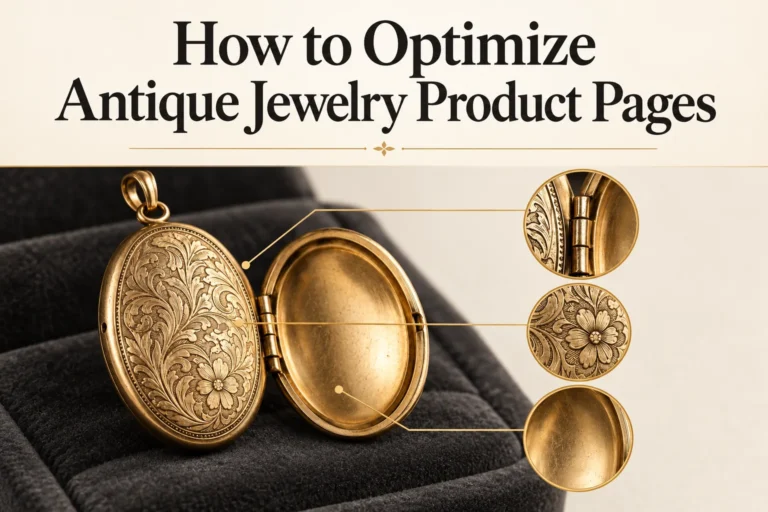
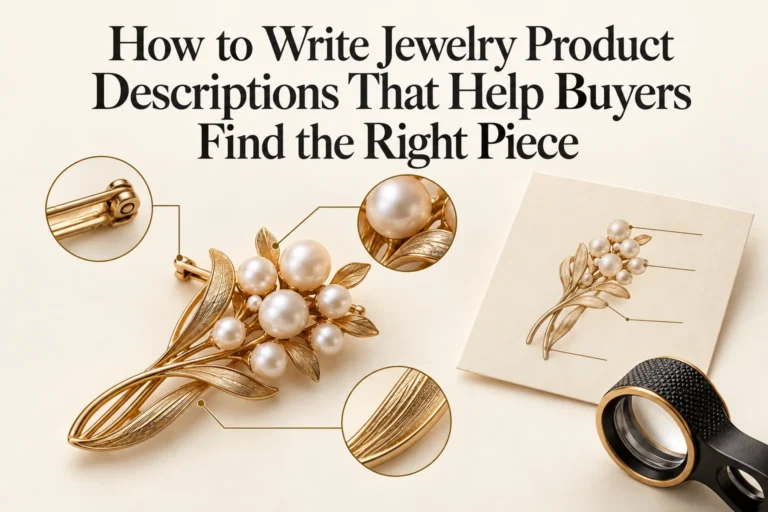
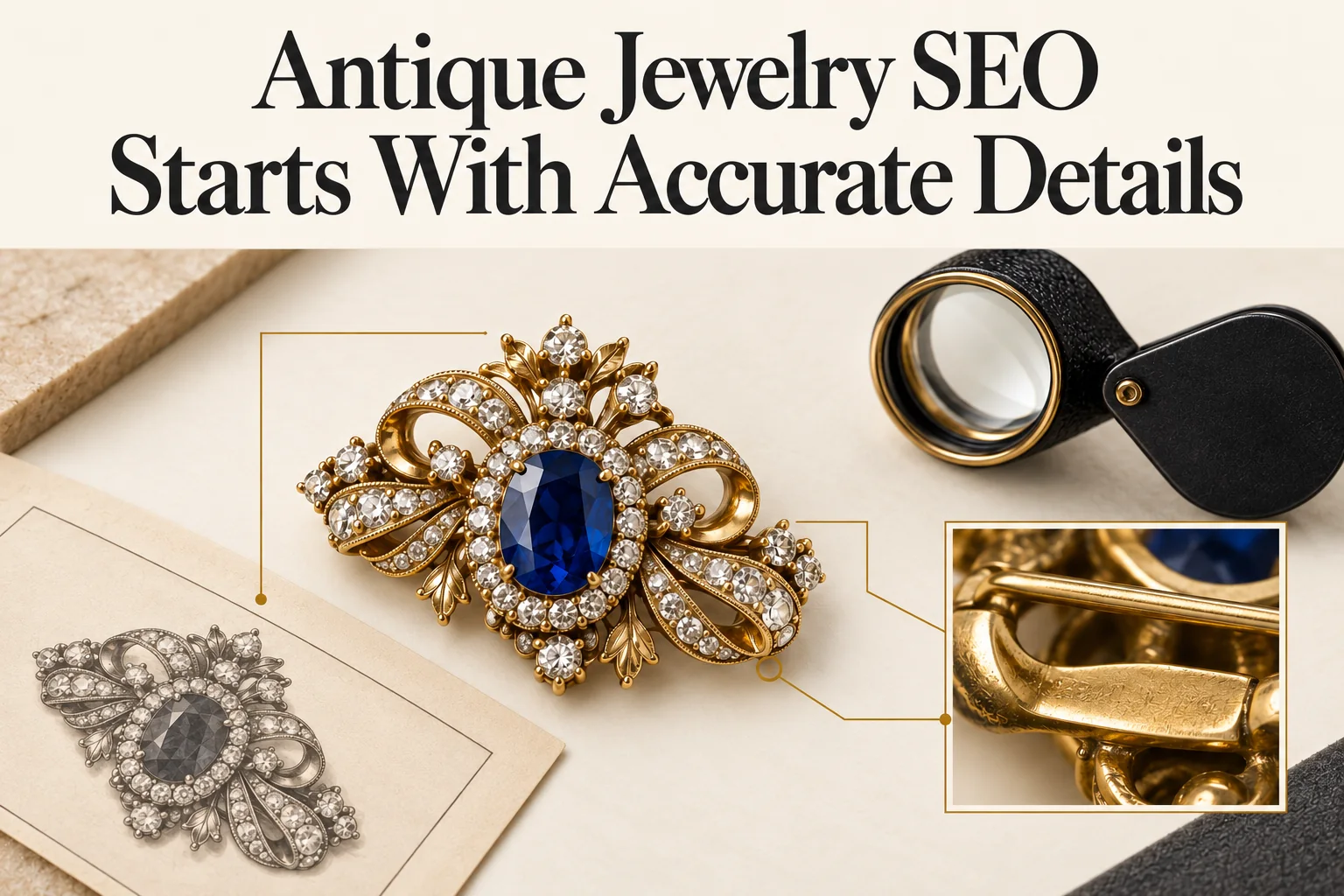
A strong hero photograph introduces the piece, but additional views explain it. Capture the back, fastening, relevant marks and condition details where appropriate. Give a sense of scale through accurate measurements and suitable photographs rather than relying on a dramatic close-up.
Do not digitally remove a condition feature that affects the buyer’s understanding. Keep product evidence separate from illustrative marketing imagery. A conceptual image can support an educational article, but it cannot prove a mark, material or repair on an actual item.
Write captions or alternative text that describe what is shown without extending the claim. If a photograph shows an indistinct mark, its text should not supply a confident reading that the product record has not established.
Treat corrections as a small publishing process
When new information changes an attribution or description, update all relevant locations. Start with the source record, then revise the product page, shorter fields and connected channels. Check whether a collection assignment also needs to change.
Keep a dated internal note of the correction and the reason. If the change affects a current customer’s understanding of a purchase, the business should decide the appropriate communication with qualified advice where needed. SEO work should not conceal a material correction or treat it merely as a keyword adjustment.
For US-facing marketing, the FTC’s guidance on jewelry representations is a useful reference point. The specific facts, market and product determine what advice your business needs; a general article cannot resolve an individual item’s compliance questions.
Make accurate information easier to discover
Clear, accessible facts help visitors understand the website, including people arriving through AI-assisted search. Keep the explanation readable, connect related content sensibly and make the responsible business easy to identify. Do not assume that adding more confident wording will make a source more credible.
Drawing on five years of SEO experience, GemRank SEO helps businesses preserve those distinctions while improving discovery. Our antique jewelry SEO service connects research and page structure with careful descriptions. Read the antique jewelry SEO guide for the broader strategy, or contact us about improving your product records and pages.