How Shopify Jewelry Stores Can Improve SEO

Running a jewelry store on Shopify can make publishing a product straightforward. Making that product easy to discover, compare and trust is a separate task. A polished theme does not automatically explain the difference between two settings, resolve confusing collections or keep sold inventory information accurate.
Shopify jewelry SEO starts with those practical gaps. Choose the pages that matter to the business, improve their information and browsing relationships, then check what the platform actually outputs.
GemRank SEO draws on five years of SEO experience to prioritize that work. The useful first question is not how many apps to install. It is where a customer currently loses the path from a relevant search to a suitable piece.
Start with one real shopping journey
Choose an important collection and several representative products. Browse the store on a phone as a first-time customer.
Can you understand the collection’s scope? Can you compare sizes and materials? Does a product page answer the questions needed before purchasing? Are shipping and returns easy to find? Is a sold piece clearly unavailable?
Write down the actual friction. “Collection titles are vague” is an actionable observation. “The store needs more SEO” is too broad to guide a change.
Use the review to establish priorities before editing every page or paying for additional tools.
Give collections a clear purpose
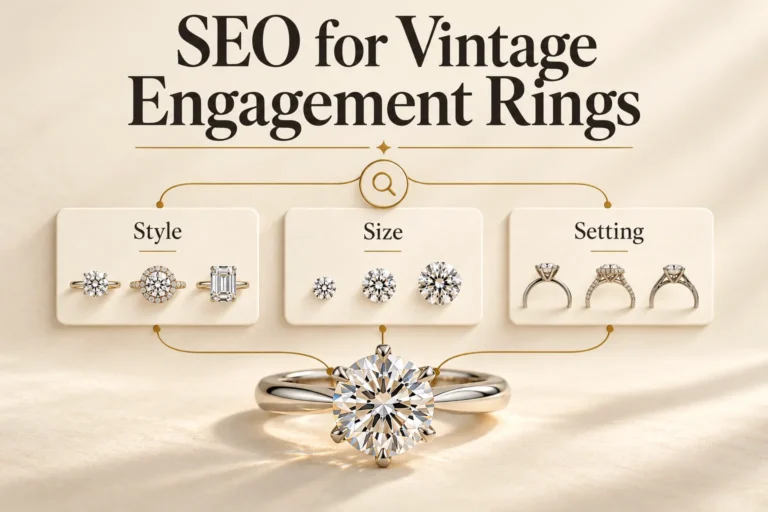
Organize important collections around a recognizable shopping need. Jewelry type, material, gemstone or occasion may provide useful routes when they match the inventory.
A hypothetical store selling gold signet rings could maintain a signet collection with accurate product details and helpful browsing information. Creating separate collections for every possible descriptive phrase may produce overlapping pages with little distinct value.
Shopify’s collections documentation describes how products can be grouped and presented. Collection controls are evolving, so check the options available in your own admin rather than following an old tutorial blindly.
Define inclusion rules and check the storefront result. An automatic rule is useful only when the product data driving it is reliable.
Make product information specific and consistent
Give each piece a clear name and opening description. Include supported metal and gemstone details, measurements, size, condition and relevant limitations. Vintage and antique inventory needs accurate attribution rather than a generic design story.
Use consistent fields or metafields where appropriate to your theme and workflow. The benefit is a predictable place for facts, not a complicated data model nobody maintains.
For a fictional listing, “Vintage Garnet Signet Ring in 9k Gold” provides more context than “The Signature Ring,” provided the material, stone and age descriptions are supported. A brand name can remain secondary.
Avoid copying the same long paragraph onto every product. Shared policies can live in reusable sections, while the individual description should explain the individual piece.
Edit search listings with the reader in mind
Review titles and descriptions for the important pages. A title should identify the subject clearly; a description should explain why someone would find the page useful.
Shopify’s keyword guidance recommends natural language in titles, descriptions and content. It also notes that search engines may show different wording from the text you provide.
Use the main topic where it clarifies the page. Do not add every synonym to a title or repeat a phrase until the copy sounds mechanical. A character-count target is a practical editing aid, not a promise about how a result will appear.
Before changing established URLs, consider existing links and the need for a suitable redirect. A neater-looking slug is not always worth an unnecessary change.
Use images that show what customers need to inspect
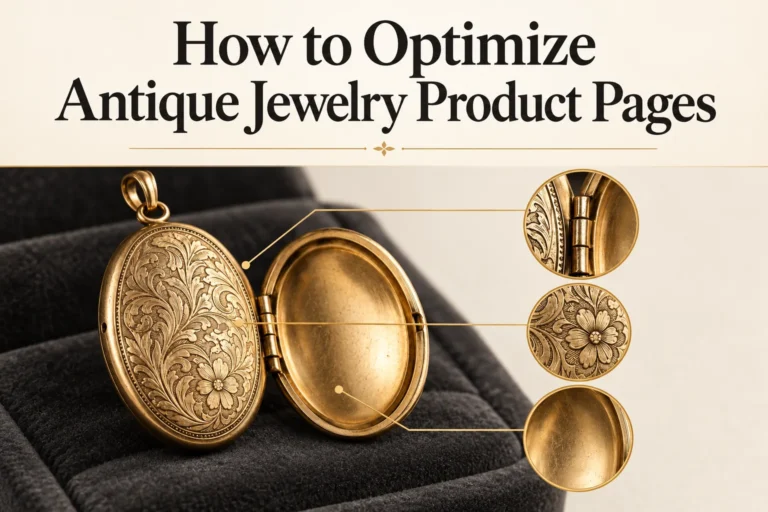
Jewelry pages need detail without excessive loading weight. Plan the main view, side profile, scale and any relevant condition or mark photographs.
Write alt text describing the actual image. “Gold signet ring shown from the side” is useful; a string of unrelated jewelry keywords is not. Google’s image guidance discusses descriptive context and accessibility.
Check the storefront’s image sizing and loading behavior instead of assuming the uploaded file is delivered identically on every device. Keep close-up detail available for inspection and avoid using enormous files for small cards unnecessarily.
Review the technical basics before making advanced changes
Important products and collections should be publicly accessible and connected through usable links. Check representative URLs, their indexability and the preferred version of pages that have multiple routes.
If you discover duplicates or unexpected exclusions, identify the cause before changing templates. A third-party app, theme modification or platform behavior can require different remedies.
Shopify says its default robots.txt configuration is designed for SEO and warns that edits can have consequences. Do not copy a blocking rule from a forum because it sounds advanced.
For more complex problems, our technical SEO service focuses on evidence, impact and verification.
Keep product data aligned with the page
Inspect price, availability and product structured data on actual listings. Google’s merchant listing documentation explains relevant requirements and testing.
An app reporting that markup exists is not the same as confirming that its output is accurate. Do not fabricate reviews or identifiers. A sold one-of-a-kind ring should not remain represented as available in one part of the system.
Give someone responsibility for the full availability update, including collection display and the customer’s next step. Otherwise a successful sale can leave a confusing page behind.
Publish content that helps shopping decisions
Choose guides that answer genuine questions about your stock. Explain how to compare relevant pieces, understand descriptions or prepare a useful inquiry. Link to appropriate collections without turning every answer into a sales pitch.
For vintage and antique stores, keep uncertainty visible. A guide about ring sizing should not imply every setting can be resized. Product-specific decisions may need qualified assessment.
Clear answers, supported facts and consistent information can help in AI-assisted discovery as well. They do not guarantee citations, and an AI-focused plugin cannot substitute for useful source content.
Make measurement part of the routine
When search and analytics tools are configured, review queries, landing pages and genuine purchase or inquiry outcomes. Track what changed and compare meaningful periods, accounting for stock and promotions.
Start with a small, practical review cycle. One improved collection and several complete listings can teach you more than a rushed rewrite of the entire catalog without a baseline.
If you want priorities matched to your store rather than a generic Shopify checklist, explore our Shopify jewelry SEO service or tell us where your store needs help. The platform gives you tools; the strategy should reflect what makes your jewelry business different. For hands-on help, see our approach to jewelry store SEO.