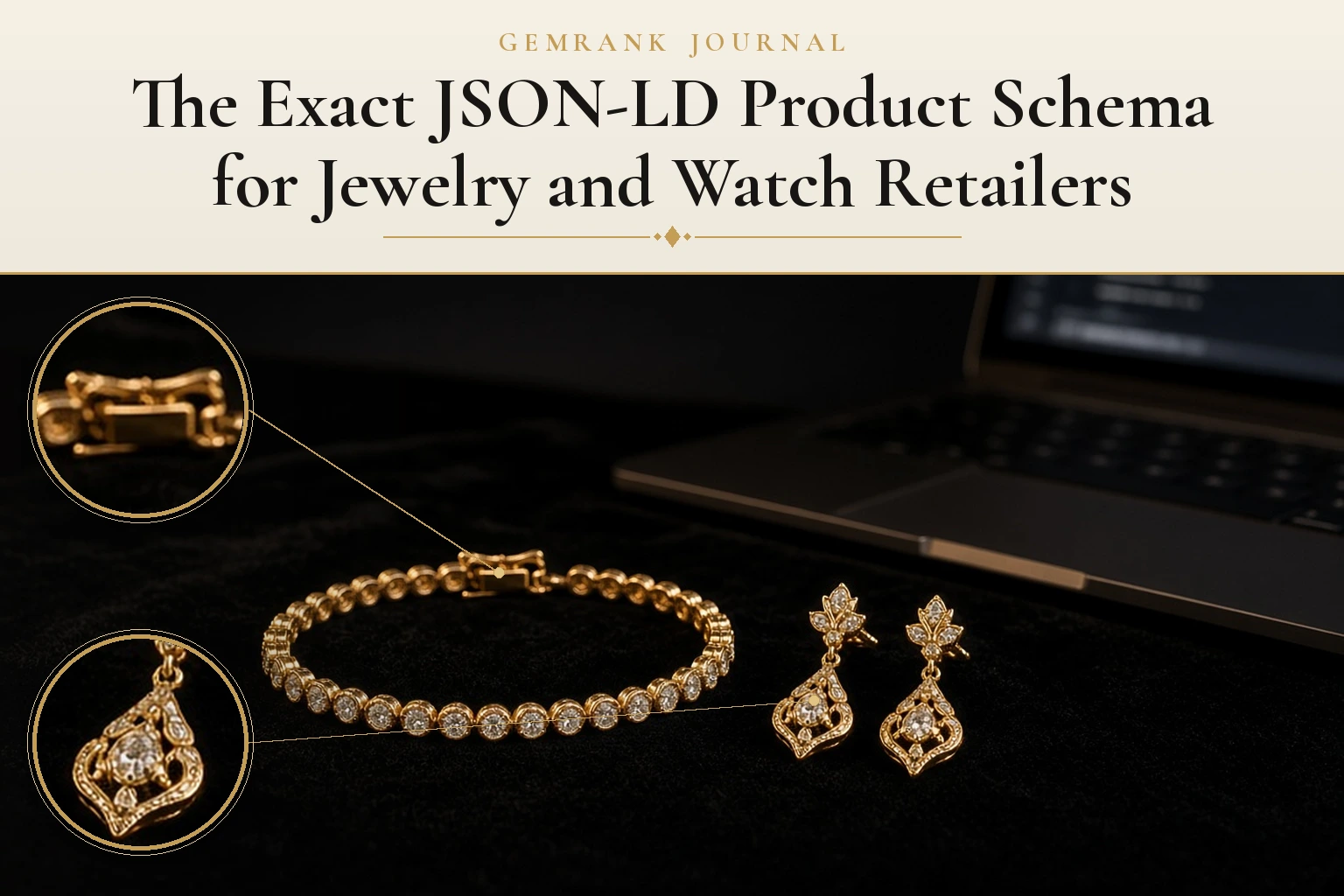
The Exact JSON-LD Product Schema for Jewelry and Watch Retailers
Jewelry and watch product pages should use schema.org Product markup in JSON-LD, with a nested Offer that states price, priceCurrency, availability and itemCondition. For vintage, antique, estate and pre-owned pieces, set itemCondition to UsedCondition. When a one-of-a-kind piece sells, change availability to SoldOut. Add brand only when there really is one (a watch maker or a signed jewelry house), describe metal with material, and add stone, carat weight and era with additionalProperty. Only add aggregateRating if the page shows genuine reviews of that specific product.
Below are three tested templates (a sold vintage ring, an in-stock estate bracelet with shipping and returns, and a pre-owned watch), plus the rules for reviews and the mistakes we see most.
The pain point: theme schema that says the wrong thing
Most jewelry themes and apps output basic Product markup automatically. It’s often incomplete or wrong for vintage stock: every piece marked NewCondition, sold pieces still listed InStock, the store name entered as the brand of a 1920s unsigned ring, and star ratings pulled from site-wide reviews. Google uses this data for product rich results and merchant listings, so wrong values can show up in search or make the page ineligible.
Why generic schema templates fall short
Generic templates are written for new, mass-produced goods. Applied to jewelry, they cause problems:
- Wrong condition. Omitting itemCondition or defaulting to NewCondition for a pre-owned piece misstates it.
- Wrong units. Some guides use the wrong UN/CEFACT unit code for carat weight. The code for metric carat is CTM.
- Invented brands. An unsigned estate piece has no brand. Putting your store name there is not accurate. Use seller for the store.
- Ratings without reviews. Adding aggregateRating with no visible reviews on the page goes against Google’s structured data guidelines.
Three tested JSON-LD templates
Each template below parses as valid JSON. Replace the example values with the piece’s real data, and make sure every value matches what’s visible on the page. Paste it inside a script tag of type application/ld+json, or map the fields in your SEO plugin or theme.
Template 1: Sold vintage ring (UsedCondition, SoldOut)
{
  "@context": "https://schema.org",
  "@type": "Product",
  "name": "Art Deco Sapphire and Diamond Ring, Platinum, circa 1925",
  "description": "Original Art Deco ring with a cushion-cut blue sapphire framed by old European cut diamonds in a hand-pierced platinum mount. Size 6.",
  "sku": "A1042",
  "image": [
    "https://example.com/images/art-deco-ring-sapphire-platinum-front.jpg",
    "https://example.com/images/art-deco-ring-sapphire-platinum-hallmark.jpg"
  ],
  "material": "Platinum",
  "color": "Blue",
  "additionalProperty": [
    {
      "@type": "PropertyValue",
      "name": "Main stone",
      "value": "Sapphire"
    },
    {
      "@type": "PropertyValue",
      "name": "Total diamond weight",
      "value": 0.45,
      "unitCode": "CTM",
      "unitText": "carat"
    },
    {
      "@type": "PropertyValue",
      "name": "Era",
      "value": "Art Deco, circa 1925"
    }
  ],
  "offers": {
    "@type": "Offer",
    "url": "https://example.com/products/art-deco-sapphire-ring-platinum-1925",
    "price": "4800.00",
    "priceCurrency": "USD",
    "itemCondition": "https://schema.org/UsedCondition",
    "availability": "https://schema.org/SoldOut",
    "seller": {
      "@type": "Organization",
      "name": "Example Vintage Jewelry"
    }
  }
}
Why each choice:
- No brand: the ring is unsigned. If it were signed (Cartier, Tiffany & Co.), add a Brand object.
- material: the metal, as plain text.
- additionalProperty: stone, carat weight with unitCode CTM, and era. These are valid schema.org properties for details Product has no dedicated field for.
- SoldOut: the piece will not return. See our guide to sold-out vintage pages for when to keep the page live.
Template 2: In-stock estate bracelet with shipping and returns
{
  "@context": "https://schema.org",
  "@type": "Product",
  "name": "Estate 14k Yellow Gold Charm Bracelet with Seven Enamel Charms, 1950s",
  "description": "Mid-century 14k gold link bracelet from a private estate, with seven enamel charms and a box clasp with safety chain. 7.25 inches.",
  "sku": "E2210",
  "image": "https://example.com/images/1950s-charm-bracelet-14k-gold-front.jpg",
  "material": "14k yellow gold",
  "weight": {
    "@type": "QuantitativeValue",
    "value": 28.4,
    "unitCode": "GRM"
  },
  "offers": {
    "@type": "Offer",
    "url": "https://example.com/products/estate-14k-gold-charm-bracelet-1950s",
    "price": "2150.00",
    "priceCurrency": "USD",
    "itemCondition": "https://schema.org/UsedCondition",
    "availability": "https://schema.org/InStock",
    "seller": {
      "@type": "Organization",
      "name": "Example Vintage Jewelry"
    },
    "shippingDetails": {
      "@type": "OfferShippingDetails",
      "shippingRate": {
        "@type": "MonetaryAmount",
        "value": "0",
        "currency": "USD"
      },
      "shippingDestination": {
        "@type": "DefinedRegion",
        "addressCountry": "US"
      },
      "deliveryTime": {
        "@type": "ShippingDeliveryTime",
        "handlingTime": {
          "@type": "QuantitativeValue",
          "minValue": 1,
          "maxValue": 2,
          "unitCode": "DAY"
        },
        "transitTime": {
          "@type": "QuantitativeValue",
          "minValue": 2,
          "maxValue": 5,
          "unitCode": "DAY"
        }
      }
    },
    "hasMerchantReturnPolicy": {
      "@type": "MerchantReturnPolicy",
      "applicableCountry": "US",
      "returnPolicyCategory": "https://schema.org/MerchantReturnFiniteReturnWindow",
      "merchantReturnDays": 14,
      "returnMethod": "https://schema.org/ReturnByMail",
      "returnFees": "https://schema.org/FreeReturn"
    }
  }
}
Google’s merchant listing documentation supports shippingDetails and hasMerchantReturnPolicy on the Offer. Only include them if they match your actual policy. If you sell on consignment, the seller is still the business that takes the order. Consignor details don’t belong in public markup.
Template 3: Pre-owned watch
{
  "@context": "https://schema.org",
  "@type": "Product",
  "name": "Omega Seamaster Automatic, Stainless Steel, 1966, with Box and Papers",
  "description": "Pre-owned 1966 Omega Seamaster automatic, 34 mm stainless steel case, serviced, with original box and papers.",
  "sku": "W0318",
  "image": [
    "https://example.com/images/1966-omega-seamaster-steel-front.jpg",
    "https://example.com/images/1966-omega-seamaster-steel-caseback.jpg"
  ],
  "brand": {
    "@type": "Brand",
    "name": "Omega"
  },
  "model": "Seamaster",
  "material": "Stainless steel",
  "additionalProperty": [
    {
      "@type": "PropertyValue",
      "name": "Case diameter",
      "value": 34,
      "unitCode": "MMT"
    },
    {
      "@type": "PropertyValue",
      "name": "Movement",
      "value": "Automatic"
    },
    {
      "@type": "PropertyValue",
      "name": "Year",
      "value": "1966"
    }
  ],
  "offers": {
    "@type": "Offer",
    "url": "https://example.com/products/omega-seamaster-1966-steel",
    "price": "3400.00",
    "priceCurrency": "USD",
    "itemCondition": "https://schema.org/UsedCondition",
    "availability": "https://schema.org/InStock"
  }
}
Watches usually do have a brand and model, so include both. If you have a reliable GTIN or MPN (common for current models, rare for vintage), add it; don’t make one up. Case size goes in additionalProperty with unitCode MMT (millimeter).
Availability and condition values to use
Google’s merchant listing documentation lists these availability values: BackOrder, Discontinued, InStock, InStoreOnly, LimitedAvailability, OnlineOnly, OutOfStock, PreOrder, PreSale and SoldOut. Supported itemCondition values are NewCondition, RefurbishedCondition and UsedCondition.
| Situation | availability | itemCondition |
|---|---|---|
| New fine jewelry, in stock | InStock | NewCondition |
| Vintage, antique or estate piece for sale | InStock | UsedCondition |
| One-of-a-kind piece, sold | SoldOut | UsedCondition |
| Piece on hold or on layaway | OutOfStock | UsedCondition |
| Consignment piece withdrawn by owner | Discontinued | UsedCondition |
| Pre-owned watch, serviced by you | InStock | UsedCondition (or RefurbishedCondition only if it meets that definition) |
| Viewable in store only | InStoreOnly | as applicable |
schema.org also defines a Reserved value, but Google doesn’t list it as supported for merchant listings, so OutOfStock is the safer choice for holds. Setting UsedCondition and SoldOut correctly on every piece is part of our vintage SEO service.
When aggregateRating and review are allowed
This is where many jewelry sites go wrong. Based on Google’s review snippet guidelines:
| Scenario | Allowed? |
|---|---|
| Customers reviewed this exact product, reviews visible on the page | Yes |
| Site-wide store reviews copied onto every product page | No; ratings must be about the specific item |
| Reviews about your business on your own homepage or about page (LocalBusiness or Organization) | Not eligible for review rich results (self-serving) |
| Ratings imported from a third party with no visible reviews on the page | No |
| A one-of-a-kind sold piece with no reviews | Leave out aggregateRating |
Because vintage pieces are one of a kind, most won’t have product reviews at all. That’s fine. Leave the property out rather than filling it.
How to add and test the markup
- Check what’s already output. Run a product URL through the Rich Results Test. Many themes already output a Product block; you want one complete block, not two conflicting ones.
- Choose one source. Either extend the theme’s output (Shopify themes and WordPress plugins often allow this) or disable it and add your own. Don’t leave two Product blocks with different values.
- Map fields to your data. Condition, availability and price should come from the product’s live data, so a sale updates the markup automatically.
- Test again. Use the Rich Results Test for Google features and the Schema Markup Validator for general schema.org validity.
- Monitor. Search Console reports Product and merchant listing issues for indexed pages.
Getting this mapped correctly across a whole catalog is part of our technical SEO work, and clean structured data also supports our AI search readiness work. Structured data is one piece of our full jewelry SEO services.
Want your product schema checked?
Book a free 30-minute consultation and we’ll test a few of your product pages together: book a free consultation.
Frequently asked questions
What schema type should a jewelry product page use?
Product, with a nested Offer. For a one-of-a-kind piece you can also use IndividualProduct, a schema.org subtype of Product, though Product alone is fine for Google.
What itemCondition should vintage jewelry use?
UsedCondition. Google’s supported values are NewCondition, RefurbishedCondition and UsedCondition, and vintage, antique and estate pieces are pre-owned.
Should I mark a sold vintage piece SoldOut or OutOfStock?
SoldOut, since it won’t come back. Use OutOfStock for temporary states such as a hold.
Can I put my store name in the brand field?
Only for products you make under your own brand. For unsigned vintage pieces, leave brand out and list your store as the seller.
Can I add star ratings to every product page?
Only where the page shows genuine reviews of that specific product. Site-wide store ratings should not be added to individual product markup.