How to Optimize Antique Jewelry Product Pages
Before an online customer asks about an antique piece, they often try to answer several questions alone. What exactly is it? How confident is the date? What has been repaired? Can I see the details that matter? If your product page makes those answers hard to find, a beautiful photograph may never lead to an inquiry.
Optimizing antique jewelry product pages means organizing accurate information around those decisions. Search visibility matters, but it should bring someone to a page that deserves their attention and gives them a sensible next step.
With five years of SEO experience behind our approach, GemRank SEO starts with the substance of a listing. A clearer page is more useful than a polished title attached to incomplete facts.
Give the item a precise, defensible title
A product title should identify the piece without trying to tell its entire story. Include the jewelry type and the most useful supported distinguishing details. A period or maker attribution belongs there only when the evidence supports it.
For a hypothetical listing, compare “The Forget-Me-Not” with “Antique Gold Locket With Blue Enamel Detail.” The latter gives a buyer an understandable starting point. An inventory name can follow if you use one, but it should not replace the description.
Do not add “Victorian” because the piece resembles something in a reference photograph. Design resemblance and documented attribution are different claims. When the date is estimated, qualify the description consistently throughout the page.
The title shown on the page and the SEO title can be closely related. They need not contain every search variation to communicate the item’s subject.
Write an opening that answers the first questions
Use the opening paragraph to explain what is being offered and why its details are distinctive. Keep factual claims specific enough to verify.
Here is an illustrative opening for a fictional, documented listing:
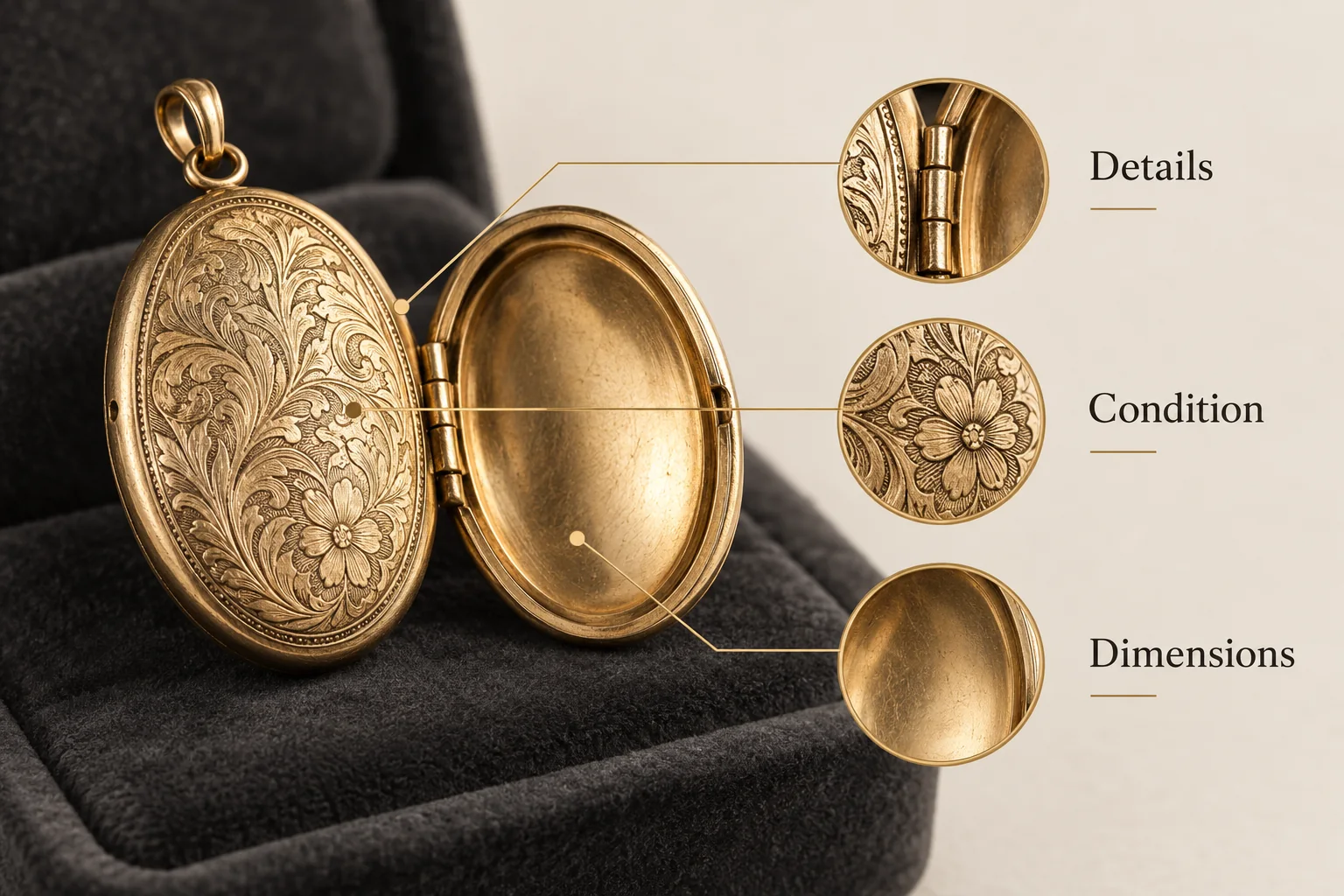
“An antique gold locket with blue enamel accents and engraved floral decoration. The interior contains two compartments. The clasp closes securely; visible enamel wear is shown in the close-up photographs.”
This example is not a real inventory description. It demonstrates how a page can introduce the piece and disclose a relevant limitation together. It does not imply an age, metal purity or gemstone assessment that has not been established.
Save the longer historical discussion for a separate section. Someone checking whether the clasp works should not need to search through romantic language to find the answer.
Create a consistent specifications section
A repeatable facts section helps buyers compare pieces and helps your team notice omissions before publication. Use the fields relevant to the item, not an oversized template that asks for meaningless values.
| Field | Editorial check |
|---|---|
| Attribution | Is the date documented, estimated or unknown? |
| Materials | Are metal and gemstone descriptions supported? |
| Dimensions | Are units clear and measurements accurate? |
| Condition | Are wear, repairs and replacements described? |
| Marks | Does the explanation match the photograph? |
| Availability | Can the customer actually buy or inquire about this piece? |
For a ring, include its actual size and qualified resizing information. For a necklace, explain the length and closure. For a brooch, show the fastening arrangement. These details are purchasing information, not optional SEO padding.
Distinguish facts from attribution
An antique page may include direct observations, testing results, documentary evidence and a specialist’s interpretation. Present them in a way a buyer can understand.
If a date is estimated from design and construction, explain that appropriately. If paperwork belongs to a gemstone, do not imply it authenticates the entire mounting. If a component was replaced, identify the component rather than calling the whole piece untouched.
GIA’s antique and vintage engagement ring guide discusses issues such as replacement stones and materials. The practical editorial lesson is to check the actual piece rather than assume all of its components share one history.
SEO copy should retain those distinctions. Removing uncertainty to make a sentence sound stronger weakens the information a careful buyer needs.
Plan images as supporting evidence
Choose views that support your written description: overall appearance, side profile, fastening, marks, relevant interior details and disclosed wear. Use an honest scale reference when useful.
Google’s image SEO guidance recommends meaningful image context and descriptive alt text. Explain what each image shows rather than repeating a promotional keyword phrase.
Keep the original-quality detail available for inspection while delivering appropriately sized files on mobile. Cropping a clasp out of every photograph may create a visually neat listing that fails to answer an important question.
AI-generated illustrations can explain a general concept in a blog. They should not replace photographs documenting the actual product for sale.
Make the next step straightforward
Place purchase or inquiry controls where visitors can find them. Explain relevant shipping, returns, payment and appointment information through accurate policies and accessible links.
If a buyer needs a condition clarification, provide a contact route that identifies the product. An inquiry should not require them to copy several facts into a general message just to establish which locket they mean.
On a phone, check the title, first photograph, opening facts and action button. Read the page as someone who has never visited your website. Is the piece available? What would you do next? Are the important disclosures visible before that action?
Connect the listing to the rest of the store
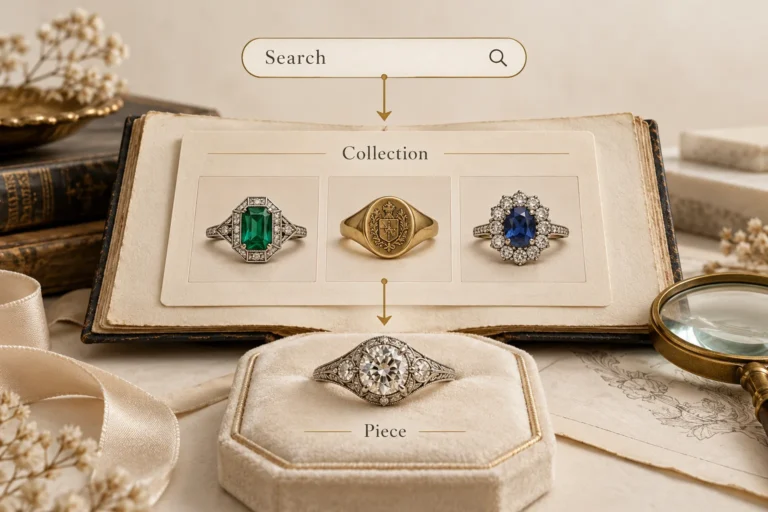
Link back to a relevant collection and offer genuinely comparable pieces where available. A locket belongs in an understandable shopping route, not only in a feed of new arrivals.
Educational links should answer a real question. A relevant guide to interpreting descriptions may help; an unrelated article added solely for an internal-link quota does not.
Our product and collection SEO service considers those relationships alongside the individual listing. Keep the product page focused on this piece and the collection focused on choices.
Check structured information and sold status
Review the product data your platform outputs. Price and availability should agree with the visible page. Do not fill missing identifiers, reviews or ratings with invented values.
When the piece sells, update the listing consistently. A useful archive can remain, but its sold label and next steps should be unambiguous. Do not continue presenting an unavailable piece as purchasable to preserve an attractive search snippet.
Evaluate the improvement, not just the keyword
Record the pages changed and the reasons. Where tracking is available, review relevant search impressions, visits and qualified product inquiries. Account for whether the item was available during the comparison period.
Clear factual sections and direct answers can also make the page more useful in AI-assisted discovery. They cannot guarantee a citation or recommendation.
If product listings are taking considerable effort without communicating that care, explore our antique jewelry SEO service or contact GemRank SEO. Start by making one page as clear as the conversation you would have with a buyer in person.