How to Write Jewelry Product Descriptions That Help Buyers Find the Right Piece
You know why a piece deserves attention. You have handled it, seen the setting from the side and noticed how the clasp works. Your customer has a screen. A strong jewelry product description closes part of that distance by giving them the details they need to understand what they are considering.
The writing should make the piece easier to find and easier to assess. Start with verified facts, identify the details that distinguish this item and explain the practical questions a buyer will have. Search terms belong naturally in that description. They should never persuade you to claim a material, period or quality you cannot support.
Start with a fact sheet, not an adjective list
Before drafting, collect the item type, materials, dimensions, size, condition, fastening and relevant documentation. Record what is included in the sale. If a pendant is photographed on a chain that is sold separately, the description needs to make that clear near the buying decision.
Separate confirmed facts, estimates and unknowns. This protects the description when several people contribute to a listing. An estimated gemstone weight should not lose its qualification when copied into a short description or a marketplace field. The same applies to attributed dates and maker information.
For US-facing sales, the FTC’s Jewelry Guides are a relevant reference for truthful product representations. Have material claims and required disclosures checked by someone qualified for your products and market. A polished SEO description is not a substitute for verifying the merchandise.
Choose the main phrase from the piece itself
Ask how a customer would identify the item if they had never seen your internal inventory name. An engraved gold locket is more descriptive than The Eleanor. You can retain a creative name, but pair it with a clear product type and supported distinguishing details.
Avoid packing every attribute into the title. The opening can establish the type, while the body explains the rest. A title should help someone recognize the product in a list; it does not need to function as the entire specification sheet.
Research candidate language against current search results and actual customer vocabulary. A phrase being specific does not prove it has measurable demand. Keep keyword research honest about what has been observed and what remains an informed hypothesis, especially for unusual one-of-a-kind pieces.
Write the opening for recognition
The first paragraph should help a reader picture the particular item. Name the feature that distinguishes it and explain it in concrete language. Describe the engraved surface, the shape of the setting or the relationship between the pendant and its chain if those facts matter to the purchase.
Avoid opening every listing with the same claim about timeless elegance. Repetition makes separate pieces feel interchangeable. It also uses the space where a customer expects to learn why this one is different.
Emotion can come from specificity. A locket that opens to hold two photographs already offers a meaningful story. You do not need to invent a previous owner, an occasion or a sentimental history to make the description engaging.
A hypothetical rewrite, with the evidence made clear
Suppose the seller has confirmed that a locket is 9k gold, measures 24 mm excluding the bail, opens for two photographs and has surface wear. Its age is not established. The following example is invented to demonstrate writing, not a description of stock for sale.
Weak opening: A stunning antique treasure, perfect for everyone and guaranteed to become your most cherished heirloom.
More useful opening: This engraved 9k gold locket opens to hold two photographs. At 24 mm long excluding the bail, it offers a compact oval shape with visible surface wear shown in the close-up photographs. Its date has not been established.
The revised version avoids an unsupported antique claim and gives the shopper something useful to evaluate. It is not necessarily the complete listing. The seller still needs to explain chain inclusion, fastening condition and any other relevant facts before publication.
Put comparison details where people can find them
Use a concise specification section for information shoppers may compare across pieces. Keep the format consistent across the catalog so a visitor does not need to hunt for measurements on each page. Use units clearly and explain whether a measurement includes a bail, clasp or other component.
| Information | Helpful wording approach | Common problem |
|---|---|---|
| Measurements | State the dimension and what it includes | A number without units or context |
| Condition | Describe the observed issue and show it | Excellent condition beside visible unexplained damage |
| Documentation | Identify the document and its scope | Calling the entire piece certified without explanation |
| Sale contents | State whether chain, box or report is included | Styling props appearing to be part of the purchase |
The table is a writing checklist, not a universal product specification. Your inventory may need additional fields. Keep details useful to the buyer rather than adding attributes simply because a plugin offers them.
Let photographs and words support each other
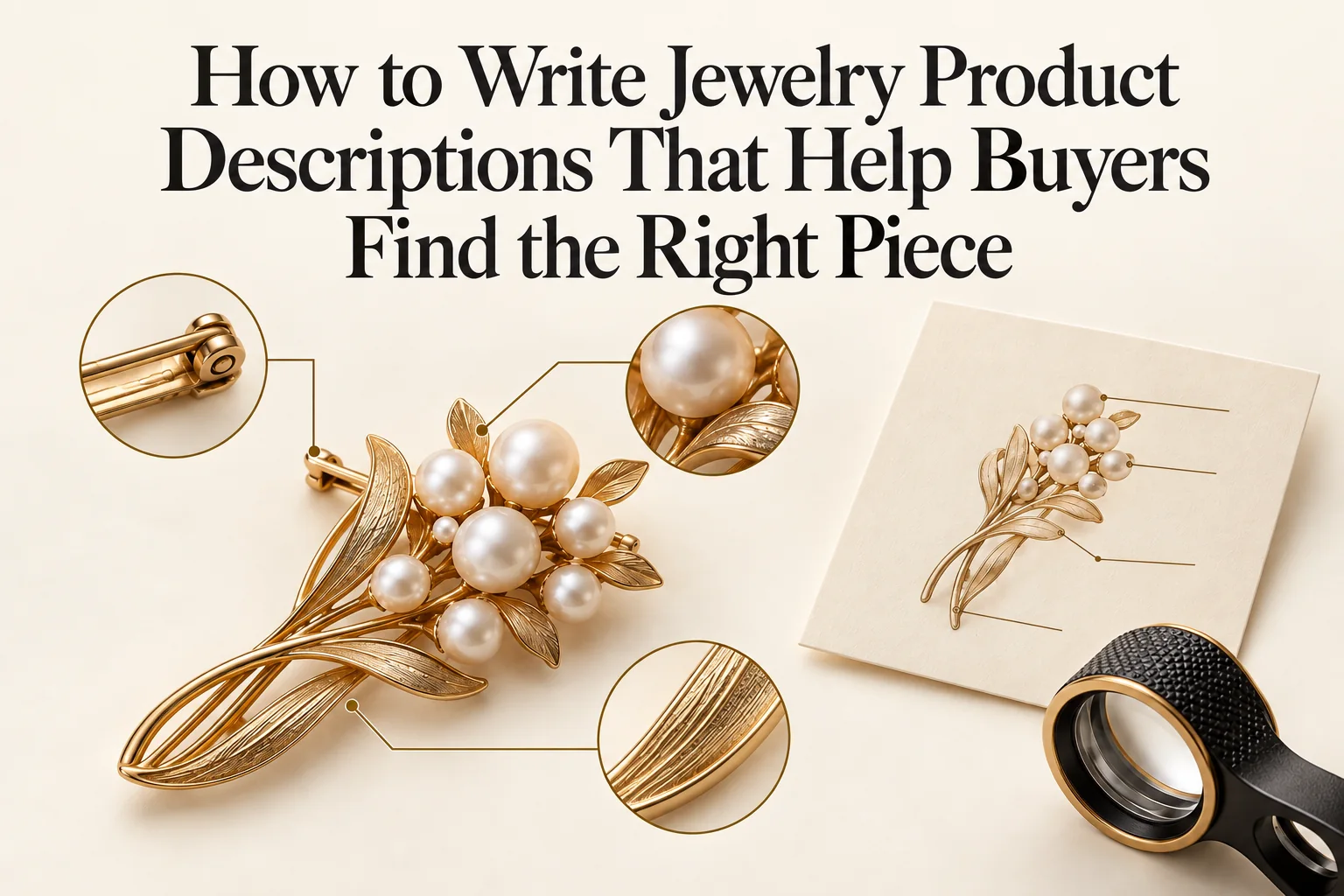
Show the features your copy discusses. If you mention an engraved back, include that view. If condition affects the decision, a general beauty shot cannot replace a clear close-up. Useful photography reduces the amount of guessing a customer must do.
Write image descriptions around the visible content. Do not repeat the same long keyword phrase for every angle. A side-profile image and a clasp close-up communicate different information, and their alternative text should reflect that distinction where text is appropriate.
Keep generated concept images out of evidence roles. They can illustrate a blog explanation, but product buyers need photographs of the actual item. Never use an illustration to suggest a hallmark, condition or construction detail that has not been observed.
Add the practical next step
Some descriptions need a direct purchase route. Others need an inquiry about sizing, inspection or a specific concern. Make the next step match what the business actually offers, and place relevant buying policies within easy reach.
Avoid hiding important qualifications below unrelated promotional material. A shopper should understand what they are buying before deciding to pay. Read the page on a phone to check whether the essential information remains close to the product and its controls.
Review the copy as a product record
Before publishing, compare every factual statement with the intake record and photographs. Check the title, short description, main copy and structured product fields together. A careful paragraph does little good if the card title or feed still contains an unsupported claim.
Ask a second reviewer to identify what they still do not know. That question often reveals useful omissions more quickly than asking whether the writing sounds luxurious. Update the record when new information arrives so the next edit starts from the corrected facts.
GemRank SEO combines five years of SEO experience with a practical focus on accurate, useful catalog content. Our product and collection SEO service connects that writing with search intent and site structure. For an antique-specific page review, see how to optimize antique jewelry product pages, or contact us about your catalog.