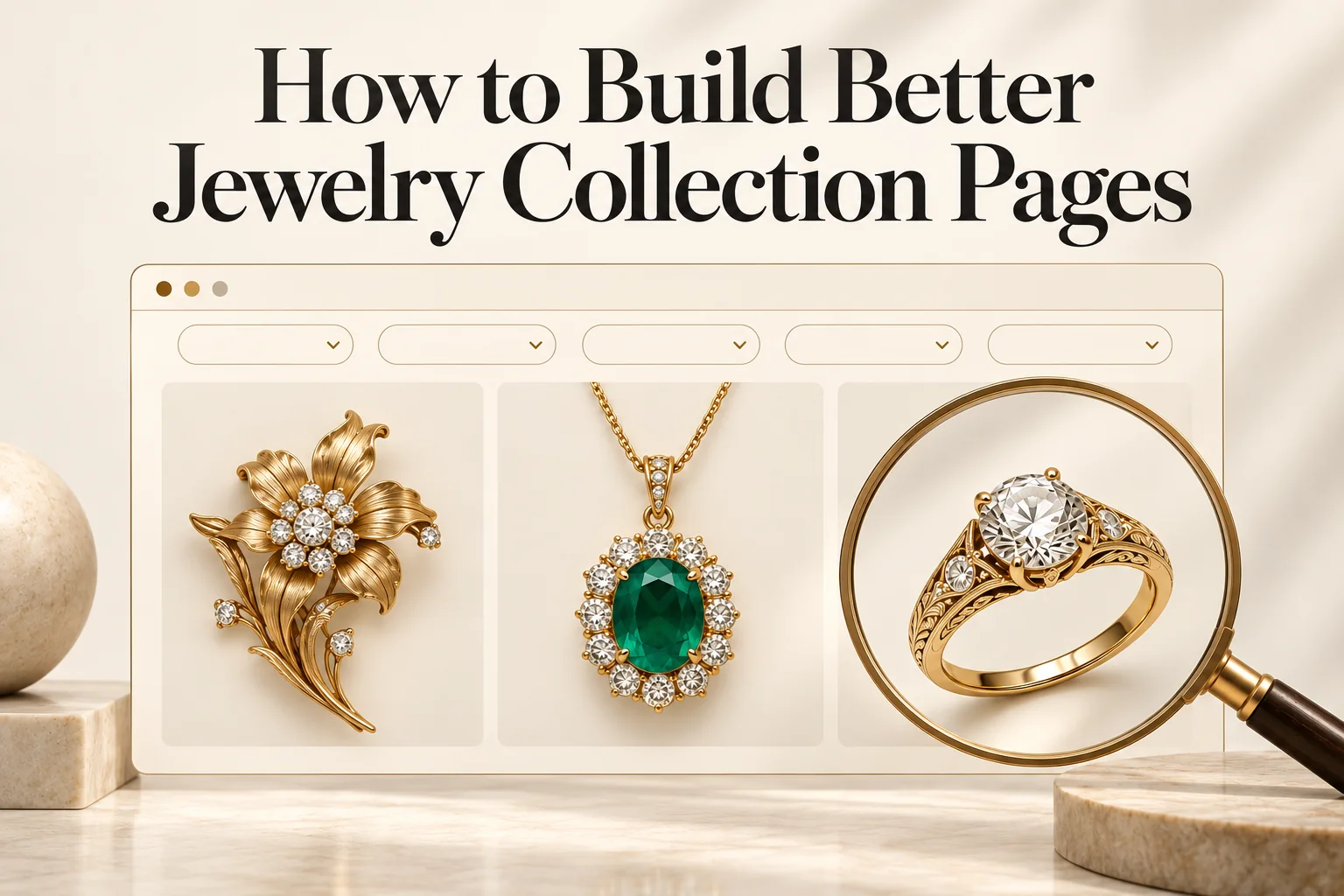
How to Build Better Jewelry Collection Pages
A collection can look beautiful and still leave a buyer uncertain. The photographs may be consistent, the heading elegant and the products desirable, yet the visitor cannot tell which pieces meet their needs. More introductory copy rarely solves that problem on its own.
Better jewelry collection pages help people make a useful first decision. This article focuses on improving an existing collection: diagnosing the search intent, identifying friction in the product grid and deciding what to change first. It is a practical editing process for a page you already have, rather than a reason to create more categories.
Start with the decision the collection supports
Open the page without looking at your administrative settings. Ask what a new visitor can reasonably choose here. If the answer is simply jewelry, the scope may be too broad. If the answer requires five qualifications and only one item meets them, it may be too narrow.
An independent brand’s everyday gold earrings collection might help shoppers compare fastening, dimensions and price. A vintage dealer’s sapphire rings collection may need clear differences in stone shape, setting, size and condition. The labels should follow the inventory and the customer’s decision, not a template borrowed from another category.
Write a one-sentence page brief: this collection helps this type of buyer compare these products. Use that sentence to evaluate the heading, introduction, filters, product cards and supporting content. Anything that does not assist the decision needs a clear reason to stay.
Check whether the search intent still fits
Use the page’s available search data to identify the queries already associated with it. Then review current results for a small selection of relevant terms. Look at the kinds of pages shown and the promise they make. This is qualitative research; it does not produce a reliable search-volume figure by itself.
A collection intended for engagement rings may attract broader sapphire ring searches. That is not automatically a problem, but the page should not force every shopper into an engagement story. Consider whether its scope or wording is unnecessarily restrictive before launching a second nearly identical collection.
Google’s Search Console performance guidance explains the query and page reporting available to site owners. Use that evidence to frame questions, then inspect the actual shopping experience. A report can show an opportunity without explaining why a visitor hesitates.
Audit the first screen before adding a long introduction
The opening should establish what is available and make the products easy to reach. A clear heading, a short useful introduction and visible browsing controls are often enough. Test the first screen on a phone, where a paragraph that seems modest on desktop may push every product out of view.
Replace generic claims with a detail that helps selection. Instead of calling a range exquisite and timeless, explain whether it contains individual vintage pieces, made-to-order designs or regularly restocked styles. Mention a relevant practical distinction only if it applies across the collection.
Longer buying guidance can sit below the grid or in a linked guide. Its position should follow usefulness. Do not add several hundred words purely to reach an assumed SEO requirement, especially when the content repeats what shoppers can already see.
Make product cards answer the next question
A product card is a small promise about the destination page. It should identify the piece and make the next click worthwhile. Consider the title, price, availability and the most useful comparison detail. Too many badges create noise; too few details force repeated backtracking.
| Collection | Useful card detail | Detail better explained on the product page |
|---|---|---|
| Vintage rings | Current size and clear availability | Whether a particular ring can be resized |
| Pendants | Pendant or necklace, with chain inclusion clear | Exact measurements and fastening photographs |
| Earrings | Pair or single and fastening type | Condition, weight and individual construction notes |
These are editorial examples, not mandatory fields for every store. Choose details that your product records can supply accurately. A beautifully designed size badge is unhelpful when half the catalog contains guessed or outdated values.
Test filters against real questions
Useful filters reduce the work of comparing suitable pieces. Start with questions customers actually ask, such as metal, gemstone, ring size or price. Check that the options are meaningful for the current stock and that selecting one does not repeatedly lead to empty results.
Keep the meaning of each filter consistent. If one product is classified by estimated period and another by visual inspiration, a period filter can mislead. Separate those concepts in the catalog before presenting them as equivalent choices.
Filters also create technical considerations. Ask whoever manages the site which filter combinations produce separate addresses and which are intended for search indexing. Do not change robots rules or canonical tags casually to tidy a report. The decision needs to reflect the site’s actual URL behavior and the value of those pages.
Fix internal links that promise the wrong destination
Follow links into the collection from the menu, homepage, guides and related products. Does their wording describe what the page now contains? A collection can drift over time while older links continue to promise something more specific.
Google’s navigation guidance emphasizes links that connect categories and products. In an improvement project, check that important available pieces are reachable through that structure, including later pages of a larger collection.
Do not link every guide to every collection. A paragraph about necklace lengths should point to a destination that helps with that decision. A smaller set of purposeful links is easier to maintain and more useful to the reader than a block of loosely related keyword anchors.
Run a small before-and-after review
Choose one collection and record its current heading, first-screen layout, filters and typical product cards. Note the date, available inventory and any tracking limitations. Then make a coherent set of changes around one problem, such as insufficient comparison information.
For a hypothetical vintage ring collection, the first revision might shorten the opening, expose ring sizes on cards and move sold pieces out of the default available selection. That is a testable shopping improvement. It does not require claiming that those changes will produce a particular ranking or conversion increase.
After enough visits to make a comparison useful, review search visibility and buyer behavior where measurement permits. Also ask whether inquiries have become more specific. If traffic rises but visitors still ask which pieces are available, the page may have a clarity problem that the search report cannot resolve.
Keep the collection worth returning to
Assign someone to review empty filters, sold items, outdated copy and broken links. A collection is a continuing part of the shop, not a launch asset to forget. Small maintenance decisions often determine whether it stays useful as the catalog changes.
GemRank SEO brings five years of SEO experience to product and collection SEO, with recommendations tied to the inventory and the buying decision. If you need a starting framework rather than an audit, our guide to vintage jewelry collections explains the foundations. To discuss an existing page, send us your website. Collection pages are one part of SEO for jewelry stores.